
Search Texas DUI Records
Texas DUI and DWI records are public court documents you can search through county clerks, district courts, and the Texas Department of Public Safety. Whether you need to look up a DWI case in Dallas, check the status of a DWI arrest in Harris County, or find court filings anywhere in the state, this guide walks you through every official source. Texas has 254 counties, and each one keeps its own criminal case records. The state also maintains several centralized databases that cover the full scope of DUI and DWI cases filed across Texas.
Texas DUI Records Overview
Where Texas DUI Records Are Kept
Texas DWI and DUI records are spread across several agencies. No single office holds every record. The type of charge and the county where the arrest happened determine where you look. For most DWI cases, you start with the county courts or district courts depending on whether the charge is a misdemeanor or a felony.
County clerks handle misdemeanor criminal records. That covers most first and second DWI offenses under Texas Penal Code Section 49.04. The County Clerk's office in each of Texas's 254 counties keeps the case file, court orders, and judgment records for Class A and B misdemeanor DWI cases. You can visit in person, submit a written request, or check online if the county runs a public search portal. Most clerks charge $1.00 per page for copies plus a $5.00 certification fee if you need a certified document.
District clerks maintain felony criminal records. A third DWI conviction in Texas becomes a third-degree felony under Texas Penal Code Section 49.09. Intoxication assault and intoxication manslaughter cases also go to District Court. If you need records for a felony DWI case, go to the District Clerk in the county where the case was filed. These offices can search by defendant name or cause number and provide copies at the standard state rate.
The Texas Department of Public Safety maintains criminal history at the state level. Their Crime Records Division acts as the state control terminal for criminal justice data. DWI convictions reported by local agencies are compiled into the statewide database. DPS also runs the driver license system, which tracks all license suspensions tied to DWI arrests across the state.
The Texas Department of Public Safety manages driver records, criminal history data, and public information requests for DUI and DWI cases statewide. The screenshot below shows the official DPS portal used for these services.
Public information requests can be submitted to Texas DPS online, by email to publicrecords@dps.texas.gov, by mail to their Austin office, or in person at 5805 N. Lamar Blvd. Learn more at dps.texas.gov.
How to Search Texas DWI Records
The fastest way to start is online. Several Texas counties run public case search portals. You can look up DWI cases by defendant name or cause number. Harris County, Dallas County, Tarrant County, and Bexar County all run their own online search tools. For counties without a local portal, the Texas Judicial Branch offers the re:SearchTX system, which covers District Courts in many counties statewide.
To search a DWI record, you typically need the full name of the person charged, the county where the arrest happened, and roughly when the case was filed. A cause number speeds things up if you have it. Most portals let you search by name alone, but you may get a lot of results in large counties like Harris or Dallas. Narrowing by year helps filter things down.
You can also request records by mail. Most county clerks and district clerks accept written requests with the person's name, case date, and your contact info. Copies cost $1.00 per page under state law, with a $5.00 certification fee. Processing times vary by county, from a few days to a couple of weeks.
Crash reports tied to DWI incidents are held by the Texas Department of Transportation under Texas Transportation Code Section 550.062. Officers must file a CR-3 Peace Officer's Crash Report within 10 days for any crash with injury, death, or property damage over $1,000. You can buy these online for $6 for a regular copy or $8 for a certified copy through TxDOT's Crash Report Online Purchase System. TxDOT retains crash records for 10 years plus the current year.
Texas DWI Laws and Penalties
Texas uses the term DWI (Driving While Intoxicated) for the main drunk or drugged driving offense. The term DUI (Driving Under the Influence) applies specifically to minors under 21 who have any detectable alcohol in their system under Texas Alcoholic Beverage Code Section 106.041. Both types of records are public and accessible through the same county and state systems.
Under Texas law, "intoxicated" has two definitions. The first is a blood alcohol concentration of 0.08 or more. The second is not having the normal use of mental or physical faculties due to alcohol, drugs, or any other substance. Prosecutors can charge under either standard. This means someone with a BAC below 0.08 can still be charged if the arresting officer observed signs of impairment. The Texas Department of Transportation notes that impairment begins before the legal limit is reached.
A first DWI offense is a Class B misdemeanor. The minimum confinement is 72 hours, and the max is 180 days. Fines can reach $2,000. If the blood alcohol level was 0.15 or higher, the charge steps up to a Class A misdemeanor with up to one year in jail and a $4,000 fine. A second offense is also Class A, with a 30-day minimum. Texas also adds state surcharges of $3,000, $4,500, or $6,000 at sentencing on top of the court-imposed fines, depending on the case.
A third DWI makes the offense a third-degree felony with two to ten years in prison and a fine up to $10,000. Prior DWI convictions include boating while intoxicated and flying while intoxicated counts. Intoxication assault under Section 49.07 is a third-degree felony when the driver causes serious bodily injury. Intoxication manslaughter under Section 49.08 is a second-degree felony when someone dies, carrying two to 20 years in prison.
DWI with a child passenger under 15 is a state jail felony regardless of prior record. That carries 180 days to two years in a state jail facility and fines up to $10,000. It is charged as child endangerment in addition to the DWI, and the driver faces an additional 180 days of license suspension on top of other penalties.
Administrative License Revocation in Texas
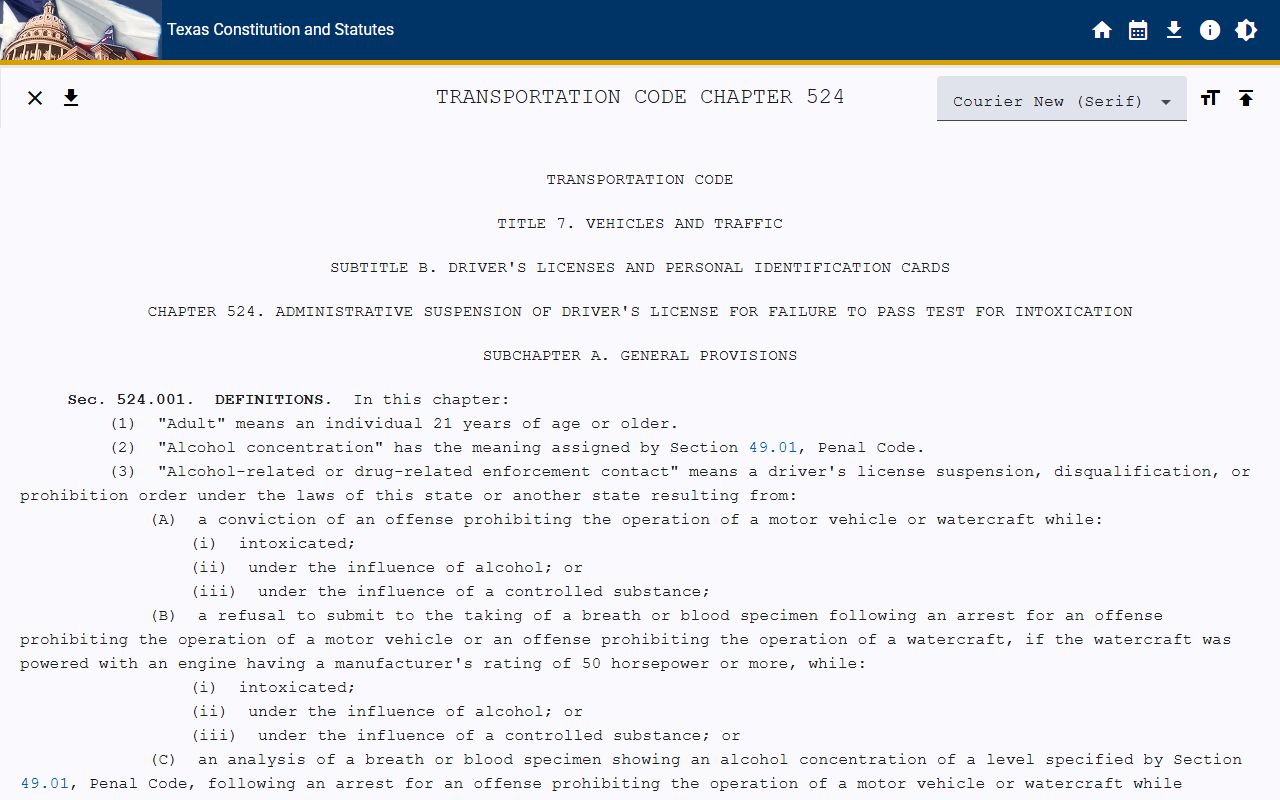
A DWI arrest triggers two separate processes. One is the criminal case handled by the courts. The other is the Administrative License Revocation (ALR), a civil process run by the Texas Department of Public Safety under Texas Transportation Code Chapter 524. The ALR process can suspend your license even if the criminal case is dismissed or you are found not guilty. These are completely separate proceedings.
After a DWI arrest, the officer takes your physical license and issues a Notice of Suspension that also serves as a temporary driving permit valid for 40 days. You have just 15 days from the date of arrest to request an ALR hearing. If you don't request one in time, the suspension takes effect automatically on day 41. ALR hearings are conducted by the State Office of Administrative Hearings, and the standard is preponderance of the evidence, which is lower than criminal court.
Suspension periods for adults 21 and older: refusing the chemical test results in 180 days for a first refusal and two years for a second refusal within 10 years. Failing the test at 0.08 or above results in 90 days for a first offense and one year with a prior suspension in the last 10 years. For drivers under 21, any detectable alcohol triggers a suspension under the zero tolerance law. After a suspension ends, a $125 reinstatement fee is required. You can check status and pay online through dps.texas.gov.
DWI Arrests, Field Tests, and Evidence
Texas peace officers can arrest without a warrant for DWI under Texas Code of Criminal Procedure Article 14.01. DWI is treated as an offense against public peace, which allows immediate on-sight arrest. Officers must be certified by TCOLE to administer standardized field sobriety tests. The three standard tests are Horizontal Gaze Nystagmus, Walk-and-Turn, and One-Leg Stand.
Breath tests require a certified Intoxilyzer operator. For blood draws, officers must generally get a warrant after the Supreme Court's ruling in Missouri v. McNeely. The warrant process follows Texas Code of Criminal Procedure Article 18.067. All blood samples must go to an accredited crime lab under Texas Code of Criminal Procedure Article 38.35 for results to be admissible in court. The Texas Alcoholic Beverage Commission also plays a role in cases where alcohol was sold or served to the driver.
Note: If an officer stops someone for public intoxication, they may have the option to release the person to a responsible adult or treatment facility instead of arresting them. That diversion option does not apply to DWI arrests, which always require a full arrest and processing.
Texas Driver Records and DWI History
Your Texas driving record shows DWI convictions, license suspensions, and crash history. Texas DPS offers several types through their records ordering page. A Type 1 Status Record shows your current license status. A Type 2 shows violations from the past three years. A Type 3 Complete History shows everything ever recorded. Prices range from $4 to $22 depending on the type. You can order your own record online. To get someone else's record, you need the DR-1 form and must meet the requirements of the federal Driver Privacy Protection Act.
Driver records cannot be ordered at a Driver License office or by phone. Use the online system or mail a completed DR-1 form to Texas DPS at Box 149008, Austin, TX 78714-9008. Mail requests take up to three weeks to process. DWI convictions stay on a Texas driving record indefinitely, though insurance companies typically focus on the three-year history for rate adjustments.
Browse Texas DUI Records by Location
Texas DWI and DUI records are maintained at the county level. Use the links below to find the courts and agencies that handle cases in your area.
Texas Counties
Each county maintains its own clerk offices and courts for DUI and DWI case records. Select a county to find local contact details, available search options, and court information.
Texas Cities
City pages cover where to search DWI records for specific cities, which county court handles the cases, and local resources available in that area.